Add Us As A Trusted Google Source
Walk into any Virginia winery tasting room and you’ll find yourself staring at a bottle with words that seem straightforward until they suddenly aren’t. What’s the difference between “Produced and Bottled By” and “Grown, Produced and Bottled By”? Does “American” on the label mean something different from “Virginia”? Wine labels pack a surprising amount of legal and agricultural meaning into a few square inches of paper, and most of us are guessing at best. This post won’t turn you into a Master of Wine, but it will make you a sharper, more confident shopper and a much better conversation partner at your next tasting.
Before we dive in, here are the key things you’ll walk away knowing:
- What the front label tells you about the wine type, grape variety, and where the grapes came from
- The difference between “Virginia,” “American,” and “Estate Grown” designations
- What phrases like “Bottled By,” “Produced and Bottled By,” and “Grown, Produced and Bottled By” actually signal about who made your wine
- What an AVA is and why it matters
- Common wine style terms such as dry, semisweet, blush, and meritage, and what they mean in plain language
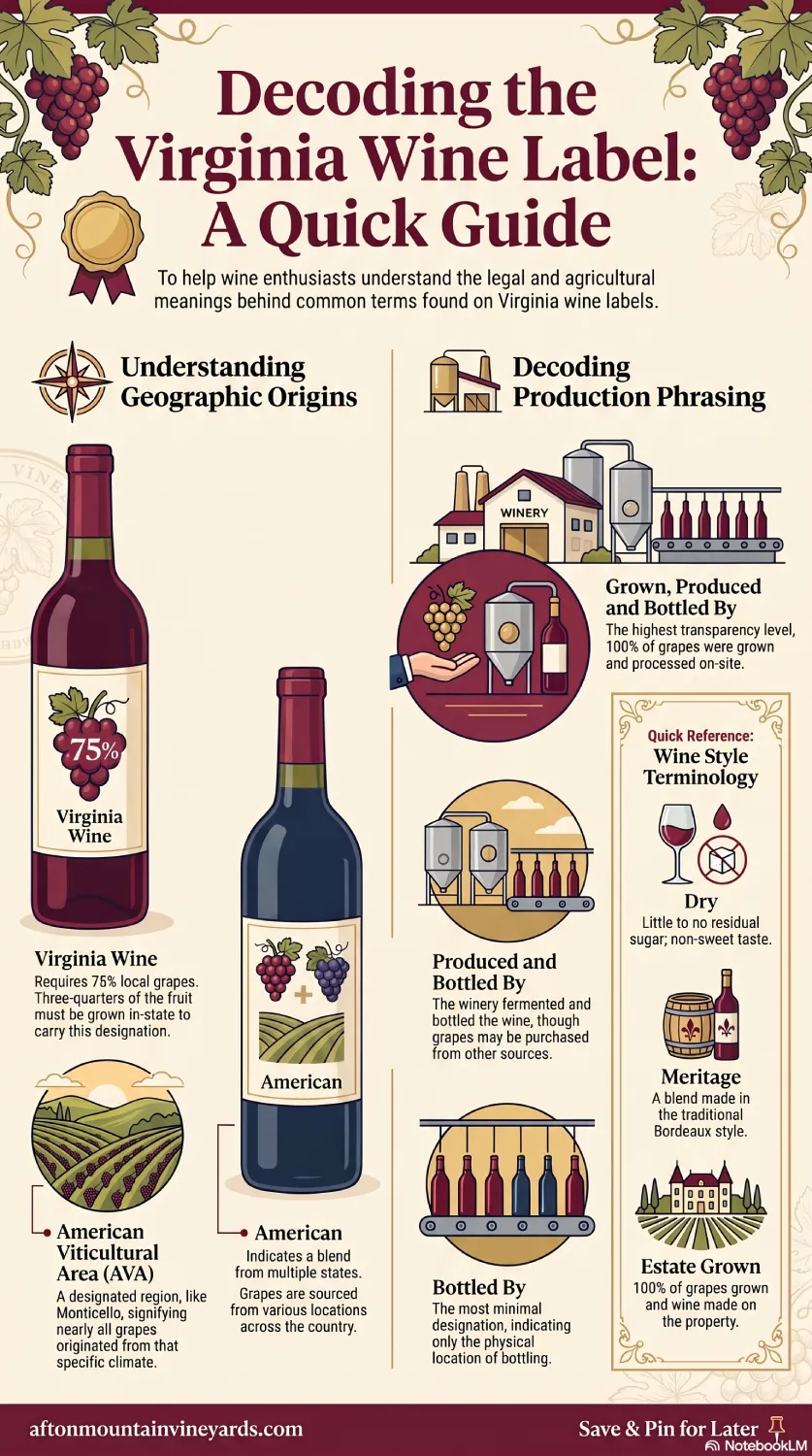
Want to share this infographic?
What’s on the Front Label, and What Does It Tell Me?
The front label is your first introduction to the wine, and every word on it carries weight. You’ll typically find:
- the winery name
- the wine type such as red, white, rosé, sparkling
- the grape variety, called the varietal (The varietal tells you the primary grape used: Cabernet Sauvignon, Chardonnay, Viognier, and so on.)
- a vintage year, which tells you when the grapes were harvested, not when the wine was bottled or released
- if you see an AVA name like “Monticello” or “Shenandoah Valley,” that’s a meaningful geographic signal: it means virtually all of the grapes in that bottle were grown in that specific American Viticultural Area.
What Does “Virginia Wine” Actually Mean on a Label?
This is where things get more specific than most people realize. When a label says “Virginia Wine,” it means at least 75 percent of the grapes were grown in the Commonwealth of Virginia. That’s a meaningful threshold as it guarantees the wine has a genuine Virginia character.
When a label simply says “American,” the rules are different. That designation means less than 75 percent of the grapes were grown in Virginia, and the winery supplemented with fruit or juice from California or elsewhere. The one consistent requirement is that at least 51 percent of the grapes must have been grown on land owned or leased by the winery. So “American” isn’t a red flag, but it does tell you the wine is more of a blend across growing regions rather than a true expression of Virginia terroir.
What Do All Those “Bottled By” Phrases on the Back Label Mean?
This is the section that trips people up most often, because the phrasing sounds similar but the meanings are quite different.
- “Bottled By” is the most minimal designation. It simply tells you who did the physical bottling and where. It doesn’t say anything about who grew the grapes or who made the wine. This phrase is typically used when the named winery wasn’t the one who grew or fermented the grapes. You’ll also see variations like “Vinted and Bottled By” or “Cellared and Bottled By.”
- “Produced and Bottled By” is the most common designation and represents the traditional winery model. “Produced” means the winery fermented the wine themselves, and the location tells you where. This is a solid, standard designation. One thing to note: it doesn’t necessarily mean the winery grew all the grapes. The winery could have purchased grapes from other growers and still legitimately use this phrase.
- “Grown, Produced and Bottled By” is the fullest expression of a winery’s ownership of its product. This means 100 percent of the grapes were grown by the named winery, in the named town, with winemaking and bottling done entirely on-site. It’s the most transparent designation you can find. Some wineries that qualify for this phrasing use “Produced and Bottled By” instead, simply to give themselves flexibility; if they use even a small amount of outside grapes in a given year, they don’t have to reprint their labels.
- “Estate Grown” is a front-label phrase that pairs closely with “Grown, Produced and Bottled By.” To use it, the winery must be located within a designated AVA, and nearly all of the grapes must have been grown on the winery’s own property in that location. It’s one of the clearest quality signals a Virginia wine label can offer.
What Is an AVA and Why Should I Care?
An AVA, American Viticultural Area, is a federally designated wine grape-growing region with distinct geographic and climatic characteristics. Virginia has eight of them, including the Monticello AVA (also called Central Virginia) where Afton Mountain Vineyards is located. When you see an AVA name on a label, it means virtually all of the grapes in that wine were grown in that region. AVAs matter because climate, soil, and elevation shape the flavor of grapes in ways that vary meaningfully from one area to the next.
What Do Wine Style Terms Mean?
A few terms worth knowing:
- “Dry” means the wine has little to no residual sugar and a non-sweet taste (think Cabernet Sauvignon or Sauvignon Blanc).
- “Semisweet” wines have more residual sugar (think Riesling or Moscato)
- “Blush” or “rosé” wines are made by allowing grape skins to briefly color the juice, not enough for red, but more than white.
- “Meritage” is a trademarked term for wines blended in the Bordeaux tradition, using grapes like Cabernet Sauvignon, Merlot, Cabernet Franc, and Petit Verdot.
- “Port” is a fortified wine that has been blended with brandy. It is higher in alcohol, typically sweet, and served after a meal.
- “Sparkling wine” is exactly what it sounds like: wine with bubbles, developed through fermentation.
- “Fruit wine” is wine made from fruits other than grapes.
Armed with these terms, your next trip through a Virginia tasting room will feel a lot less like guesswork and a lot more like an informed adventure. Cheers.